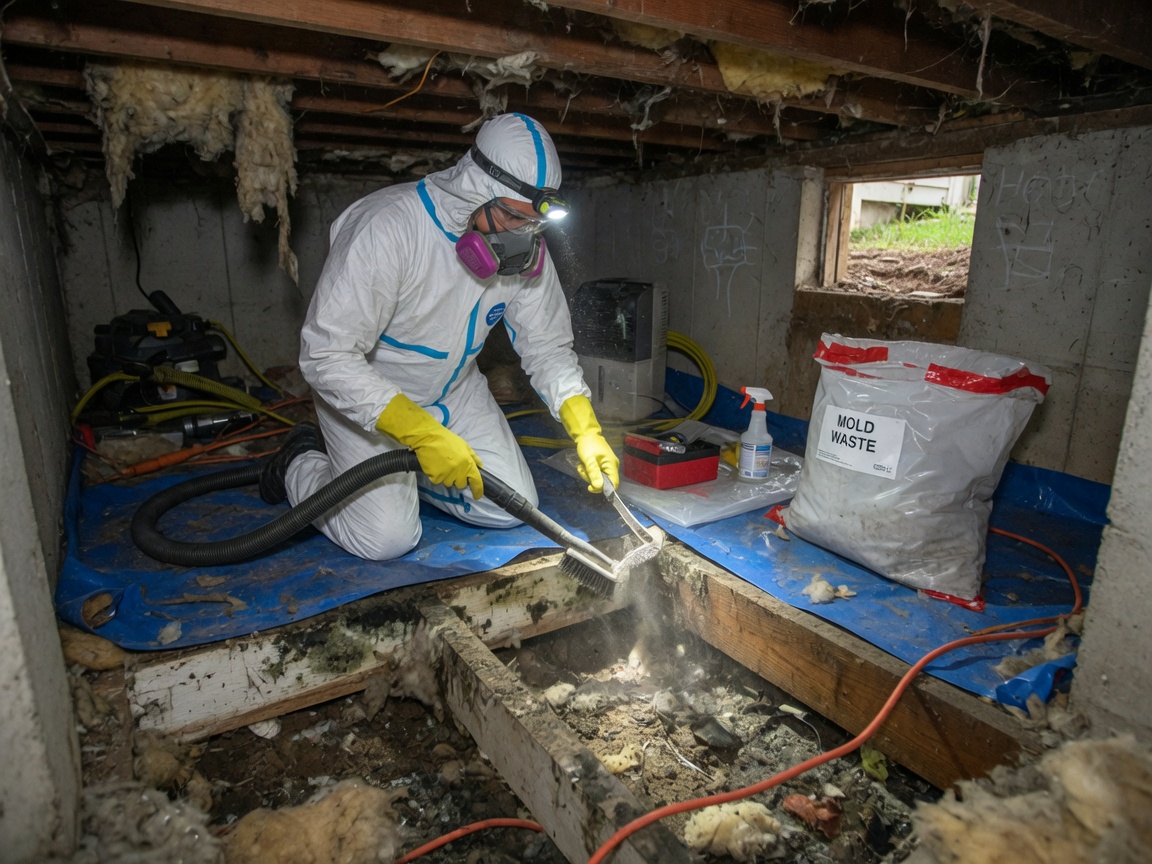
Cary homes in neighborhoods like Preston and Kildaire Farms often sit on pier-and-beam foundations with dirt crawl spaces that trap moisture from Wake County's hot summers and mild winters. Once relative humidity climbs above 60 percent, mold colonizes insulation, floor joists and ductwork. Technicians start by mapping airflow patterns created by vents that pull in humid air from outside, then isolate the space before any disturbance to keep spores from reaching living areas above.
Removal work here frequently involves cutting out saturated fiberglass batts that have been in place since the 1980s or 1990s, followed by HEPA vacuuming of exposed soil and framing. Because many Downtown Cary and Amberly properties have low clearance, crews use portable dehumidifiers sized for the square footage rather than whole-house units. After cleaning, a 12-mil vapor barrier sealed to the foundation walls and piers stops ground moisture from re-entering, a step that directly addresses the clay-heavy soils common throughout the county.
Homeowners sometimes attempt bleach sprays or fans alone, yet those steps fail when the source remains the damp earth under the house. Proper remediation also includes checking for plumbing leaks near the water heater or washing machine that sit above the crawl space, since even small drips keep relative humidity elevated year-round in this climate.
Final clearance testing confirms spore counts inside the crawl space match outdoor levels before any new insulation is installed, protecting both the structure and indoor air quality for families living above.
Technician insight
In Cary the thing that catches most people out with Crawl Space Mold Removal is the combination of older vented foundations in Preston and Kildaire Farms homes plus our long humid summers that keep soil moisture high even in mild winters. Homeowners often add a fan thinking it will dry the space, yet that just pulls more outside air across the dirt floor and restarts the cycle.
Amberly Home With Hidden Joist Growth
A Preston-area resident noticed musty air near floor registers during summer. Inspection revealed black growth on floor joists above a poorly vented crawl space where a slow plumbing drip had kept the soil wet. Crews contained the space, removed insulation, treated framing, and installed a sealed vapor barrier. Follow-up readings showed humidity stabilized below 50 percent and the odor disappeared.
Crawl Space Mold Removal Services We Offer
✓Vapor Barrier Installation
Seals dirt floors and foundation walls with 12-mil reinforced poly to cut ground moisture that feeds mold in Cary crawl spaces.
✓Insulation Removal and Replacement
Extracts saturated fiberglass or cellulose from joists and installs new material rated for high-humidity environments common in Wake County.
✓Crawl Space Encapsulation
Creates a conditioned, sealed envelope that stabilizes temperature and humidity for homes in Preston and Amberly.
✓Ductwork Mold Cleaning
Removes growth from HVAC ducts routed through crawl spaces and restores airflow without spreading spores into living areas.
✓Sump Pump and Drainage Fixes
Addresses standing water near foundation walls that keeps soil wet under older Kildaire Farms and Downtown Cary homes.
Crawl Space Mold Removal Cost in Cary, NC
| Service | Typical Range | What Affects It |
|---|---|---|
| Initial Crawl Space Inspection | Free | Includes moisture readings and photo report for Cary homes |
| Small Area Removal Under 200 sq ft | $1,200–$2,000 | Varies with access difficulty and insulation type |
| Full Crawl Space Remediation | $3,500–$6,500 | Includes barrier, drying, and disposal for typical 1,000–1,800 sq ft spaces |
| Vapor Barrier Upgrade Only | $1,800–$3,200 | 12-mil poly sealed to foundation in dry but unlined spaces |
Ranges are typical for Cary, NC and confirmed with an exact written quote before any work starts.
How it works
- 1
Site Assessment
Technicians enter the crawl space to measure moisture, identify growth locations, and note access limitations typical in Cary homes.
- 2
Containment Setup
Plastic sheeting and negative air machines isolate the work zone so spores do not reach finished rooms above.
- 3
Material Removal
Saturated insulation, wood, and debris are extracted and bagged for disposal while HEPA filtration runs continuously.
- 4
Drying And Treatment
Air movers and dehumidifiers bring moisture levels below 50 percent before any antimicrobial application.
- 5
Barrier And Clearance
New vapor barrier is installed and post-remediation air samples are taken to confirm the space meets outdoor spore counts.
Pricing
Cost depends on square footage, clearance height, and whether insulation must be replaced.